What Real-Time Fleet Tracking Actually Means

"Real-time" is marketing language unless you know the specifics. True real-time tracking for courier operations means:

Location updates every 5–30 seconds — not every 2 minutes (which is "near real-time" but shows vehicles in the wrong place on a busy city route)

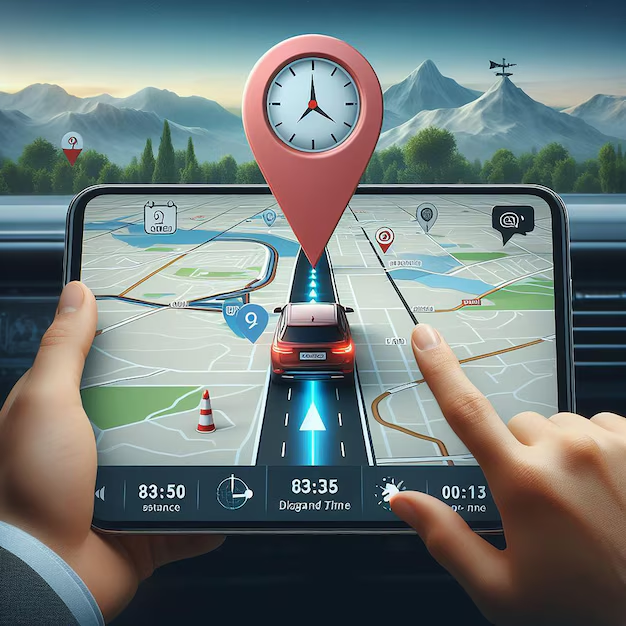
Map display with all active drivers — dispatcher can see every driver's current position, current stop, and queue

ETA recalculation — as drivers move, ETAs for remaining stops update automatically

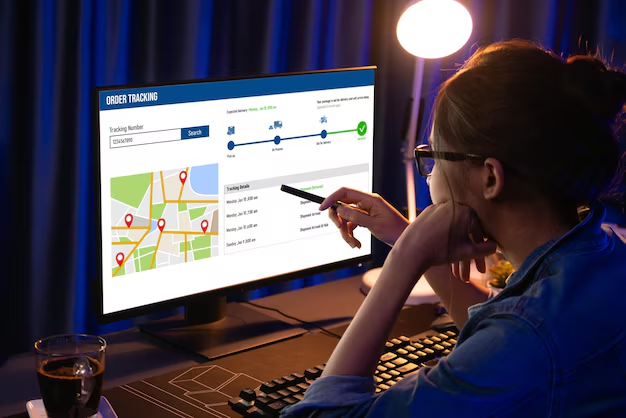
Customer-facing tracking link — customers can see their specific driver's position on a public URL

Many platforms advertise "real-time tracking" but poll every 2–5 minutes. In delivery, 5 minutes is a long time: a driver can travel 2–3 kilometers, miss a turn, or sit in unexpected traffic. 5-minute updates feel real-time to a manager looking at a screen; they're completely inadequate for the driver and customer experience.

How Real-Time Tracking Works Technically

The driver's mobile app transmits GPS coordinates to the platform's servers at a set interval (typically every 5–30 seconds). The platform processes these coordinates, updates the driver's position on the dispatcher map, recalculates ETAs, and serves the updated position to any customer tracking links watching that driver.

The key technical factors that affect tracking quality.

GPS accuracy Modern smartphone GPS is accurate to 3–5 meters under open sky. In dense urban areas (tall buildings, narrow streets), accuracy can degrade to 10–20 meters. Indoor accuracy is poor. The platform should handle GPS jitter gracefully — not showing the driver zigzagging between two points when they're stationary.

Update frequency vs. battery life More frequent updates = better tracking accuracy = more battery drain. At 30-second intervals, GPS-enabled delivery apps drain approximately 15–20% of battery per hour. Drivers doing 8-hour shifts need either charging solutions in vehicles or battery-efficient apps.

Good platforms use adaptive update rates: more frequent when the driver is moving, less frequent when stationary (waiting for a customer, loading).

Connectivity requirements The driver's phone needs data connectivity to transmit location. In areas with poor coverage, location updates queue locally and upload when connectivity returns. Dispatchers should know their platform's behavior in offline scenarios — does tracking stop, or does it resume from the last known position?

Real-Time Tracking for Customer Communication

The customer-facing tracking link is one of the most impactful features in any delivery platform. Done well, it:

  • Reduces inbound "where's my delivery?" calls by 40–60%

  1. Improves customer availability (customer sees driver is 10 minutes away, goes to door/gate)

  • Reduces failed deliveries (customer was home because they saw the driver coming)

  • Creates a premium brand experience at zero marginal cost per delivery

What makes a good tracking link?

Mobile-optimized — customers view on phones; must render well on 4-inch screen

Accurate ETA — "18 minutes" that becomes "5 minutes" on schedule, not "18 minutes" that becomes "45 minutes"

Driver contact option — click to WhatsApp or call driver if needed

Clean, branded design — your company's colors and logo, not the software vendor's branding

The WhatsApp tracking experience in MENA

In MENA markets, the most effective delivery notification is a WhatsApp message with the tracking link embedded. Customers tap the link in WhatsApp and see the live map immediately.

Some platforms support "reply to reschedule" — if the customer types "tomorrow" or similar back to the WhatsApp notification, the system offers rescheduling options. This is a significant capability for reducing failed deliveries.

Evaluating Fleet Tracking Platforms

What is your map update frequency for drivers?

The answer should be a specific number (every 10 seconds, every 30 seconds). Vague answers suggest the update rate isn't something they're proud of.

Can I see the customer tracking link? What does it look like on mobile?

Evaluate the customer experience directly, not through screenshots in the sales deck.

How does tracking behave when a driver loses cellular signal?

The answer reveals offline architecture quality. "Tracking pauses" is acceptable. "We lose all data from that period" is a red flag.

What is the battery impact of your driver app running GPS all day?

Request data from actual operations, not lab testing. Real-world battery drain in delivery routes (constant movement, app switching) is higher than controlled tests.

Does your tracking work in areas with weak signal?

For operations in rural areas, industrial estates, or basement loading docks, this matters.

The ROI of Real-Time Tracking

For a 30-driver courier operation handling 1,500 deliveries/day:

Reduced failed deliveries:

Pre-tracking failed delivery rate: 12%

Post-tracking failed delivery rate: 5% (customer sees driver coming, is available)

Savings: 105 failed deliveries/day × $15 redelivery cost = $1,575/day = $574,875/year

Reduced customer support calls:

Pre-tracking inbound "where's my delivery?" calls: 120/day

Post-tracking: 50/day

Savings: 70 calls/day × $8 handling cost = $560/day = $204,400/year

Combined annual value: $779,275

The cost of tracking software at this operation size: typically $500–$2,000/month ($6,000–$24,000/year).

ROI: 32x to 130x return on software cost.

Fleet Tracking for MENA Operations

Two MENA-specific considerations:

1. WhatsApp notification integration Customer tracking links sent via SMS in MENA achieve much lower engagement than WhatsApp. A tracking link sent via WhatsApp is opened and viewed significantly more often. This directly translates to better customer availability when drivers arrive.

iCargos includes native WhatsApp Business API integration for tracking link delivery — not a workaround, but a built-in notification channel.

2. GPS pin navigation for informal addresses In areas without standard addresses, driver navigation must work from GPS coordinates, not text addresses. Fleet tracking for these operations requires the map to center on the pin, and navigation apps must accept coordinate-based destinations.

Getting Started

iCargos includes real-time fleet tracking with 10–30 second update rates, customer-facing tracking links, WhatsApp notification support, geofencing, and route adherence reporting — all as part of the core delivery management platform.

Free trial available at iCargo— no credit card required.

iCargos © Copyright 2025. All Rights Reserved. - Powered By IT Vision Pvt. Ltd.