Software — iCargos

What Is Courier Management Software?

Courier management software (CMS) is a digital platform that helps courier, cargo, and logistics companies manage their entire delivery operation from a single dashboard. It replaces spreadsheets, phone calls, and paper-based tracking with automated workflows that handle everything from order intake to proof of delivery.

At its core, courier management software connects three critical elements of any delivery business: the operations team managing orders and dispatch, the drivers executing deliveries in the field, and the customers tracking their parcels in real time. When these three elements work in sync through a unified platform, delivery businesses see dramatic improvements in efficiency, accuracy, and customer satisfaction.

The global last-mile delivery market is projected to reach $200 billion by 2027, and courier companies that operate without dedicated management software are increasingly falling behind. Whether you run a small local courier service with 5 drivers or a multi-country logistics operation with hundreds of vehicles, the right courier management software can be the difference between growth and stagnation.

The Problem with Manual Operations

Many courier businesses — especially in emerging markets across Africa, the Middle East, and South Asia — still rely on manual processes:

  • WhatsApp groups for driver communication and dispatch

  • Excel spreadsheets for order tracking and invoicing

  • Phone calls to provide customers with delivery updates

  • Paper manifests for proof of delivery

  • Manual calculations for COD reconciliation

This approach might work with 20-30 deliveries per day. But as order volumes grow, manual processes create cascading problems:

Delivery failures increase

without optimized routing and real-time tracking, drivers waste time and miss delivery windows

Customer complaints spike

buyers expect real-time tracking; "I'll check and call you back" doesn't cut it anymore

Cash leakage

manual COD management leads to discrepancies, delayed settlements, and even fraud

Scaling becomes impossible

hiring more staff to manage growing orders creates a linear cost problem

No data for decisions

without analytics, you're running blind

The ROI of Courier Management Software

At-a-glance charts your customers will love:

  • 25-40% reduction in delivery failures through route optimization and real-time tracking

  • 30-50% decrease in customer support inquiries thanks to automated notifications

  • 20-35% improvement in driver productivity through optimized dispatch and routing

  • Near-zero COD discrepancies with digital collection tracking and automated reconciliation

  • 50-70% faster order processing through automated workflows

For a courier company processing 500 deliveries per day, even a 10% efficiency improvement translates to significant monthly savings in fuel, labor, and customer retention costs.

Key Features of Courier Management Software

Order Management & Intake

The foundation of any courier management system is how it handles incoming orders. Modern platforms support multiple intake channels:

  • Manual entry through a web dashboard

  • API integration with eCommerce platforms (Shopify, WooCommerce, Magento)

  • Bulk upload via CSV/Excel files

  • Customer portals where shippers can create orders directly

  • WhatsApp ordering for markets where messaging-based commerce dominates

Look for software that automatically validates addresses, assigns tracking numbers, calculates shipping rates, and categorizes orders by priority, zone, or delivery type.

Automated Dispatch & Assignment

Smart dispatch eliminates the guesswork of manual driver assignment. The software considers:

  • Driver location and current workload

  • Delivery zones and geographic proximity

  • Vehicle capacity and order size/weight

  • Delivery time windows and priority levels

  • Driver skills (fragile items, VIP customers, etc.)

Advanced systems use AI-powered dispatch that learns from historical data to make increasingly accurate assignment decisions.

Route Optimization

Route optimization is where courier management software delivers the most tangible ROI. Instead of drivers choosing their own routes (which are rarely optimal), the software calculates the most efficient multi-stop route considering:

  • Real-time traffic conditions

  • Delivery time windows

  • Vehicle capacity constraints

  • Road restrictions and access limitations

  • Stop priority and sequence logic

A well-optimized route can reduce daily driving distance by 20-30%, directly cutting fuel costs and enabling more deliveries per driver per day.

Real-Time Tracking & Visibility

Both operations teams and customers need real-time visibility:

For Operations:

  • Live map showing all active drivers and their current locations

  • Status updates for every order (picked up, in transit, out for delivery, delivered)

  • Alerts for delays, route deviations, or missed deliveries

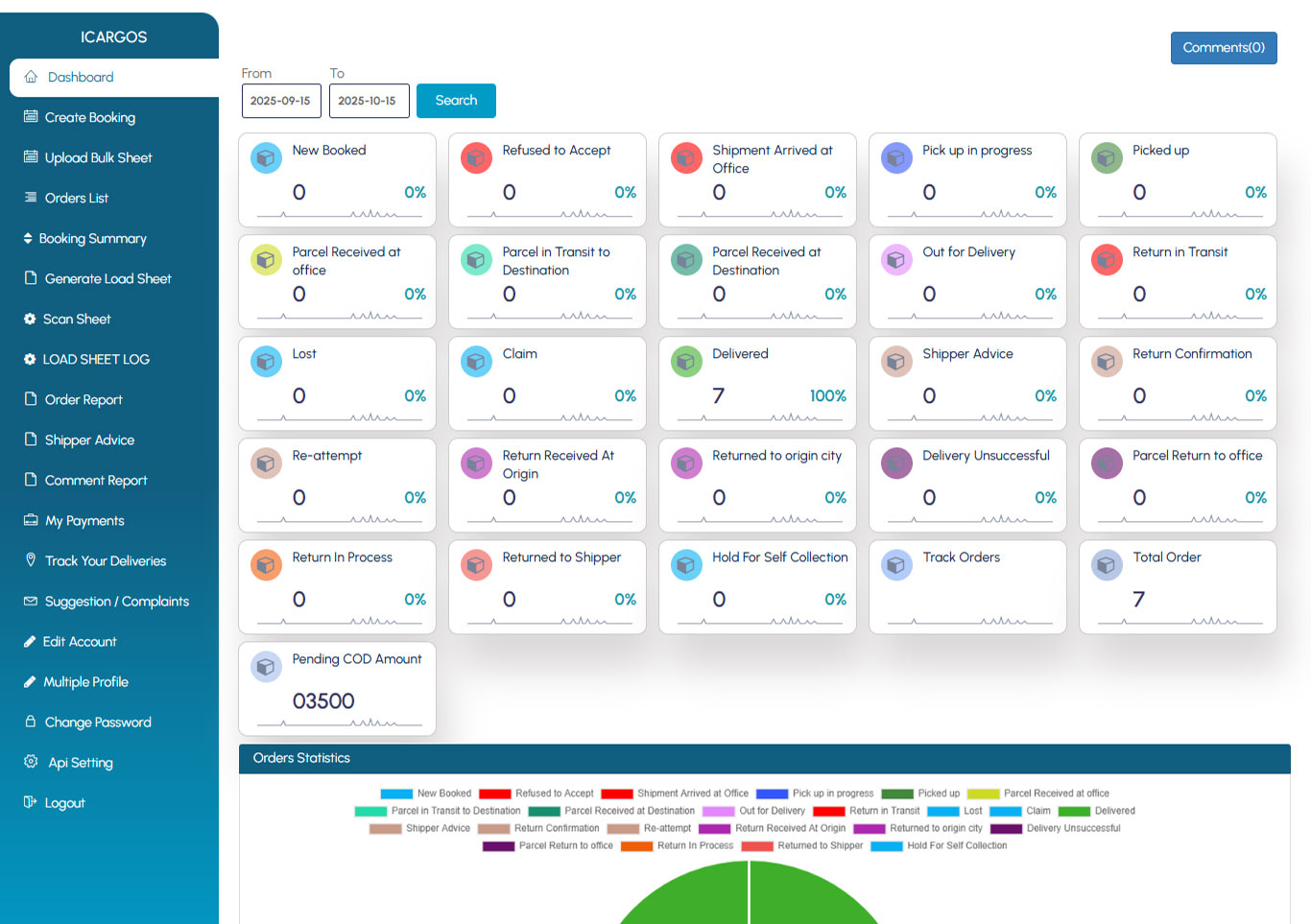
  • Dashboard showing key metrics in real time

For Customers:

  • Branded tracking page with live driver location

  • Estimated time of arrival (ETA) that updates dynamically

  • SMS/WhatsApp/email notifications at every status change

  • Option to communicate with the driver directly

Proof of Delivery (POD)

Digital proof of delivery eliminates disputes and provides an audit trail:

  • Photo POD — driver captures a photo of the delivered package

  • Signature capture — recipient signs on the driver's mobile device

  • OTP verification — recipient confirms delivery with a one-time password

  • Barcode/QR scanning — scan package barcode to confirm delivery

  • GPS stamp — automatic location and timestamp logging

All POD data should be instantly accessible through the management dashboard.

Cash on Delivery (COD) Management

In many markets — particularly the Middle East, Africa, and South Asia — COD represents 50-80% of all deliveries. Proper COD management requires:

  • Real-time COD collection tracking per driver

  • Automated reconciliation between collected amounts and order values

  • Settlement workflows for transferring funds to shippers/merchants

  • Discrepancy alerts when collected amounts don't match expected amounts

  • Driver wallet management for tracking outstanding COD balances

  • Reports showing COD collection rates, pending amounts, and settlement status

Without automated COD management, courier companies face significant cash leakage — studies show manual COD processes result in 2-5% discrepancies.

Driver Mobile App

The driver app is the field-facing component of courier management software. Essential features include:

  • Task list showing assigned deliveries in optimized order

  • Turn-by-turn navigation to each delivery point

  • One-tap status updates (arrived, delivering, delivered, failed)

  • POD capture (photo, signature, OTP)

  • COD collection recording

  • Offline mode for areas with poor connectivity

  • Communication with dispatch and customers

The app should work on affordable Android devices (not just flagship phones), since many drivers in emerging markets use budget smartphones.

Customer & Shipper Portal

A self-service portal for your business customers (shippers/merchants) reduces your operational overhead:

  • Order creation and bulk uploads

  • Real-time order tracking

  • Invoice and billing access

  • COD settlement reports

  • Analytics on their delivery performance

  • Pickup scheduling

Warehouse & Hub Management

For companies operating distribution centers, sorting hubs, or warehouses:

  • Inbound receiving and barcode scanning

  • Sorting by route, zone, or carrier

  • Outbound dispatch management

  • Inventory tracking for fulfillment operations

  • Hub transfer management for multi-hub networks

Reporting & Analytics

Data-driven decision making requires comprehensive reporting:

  • Delivery performance — success rates, on-time percentages, failure reasons

  • Driver productivity — deliveries per hour, distance traveled, idle time

  • Financial reports — COD collections, billing, revenue per delivery

  • Customer insights — order volumes by shipper, growth trends

  • Operational efficiency — average delivery time, cost per delivery, capacity utilization

WhatsApp & Communication Integration

In markets across Africa, the Middle East, and South Asia, WhatsApp is the primary communication channel. Leading courier management platforms integrate WhatsApp for:

  • Customer notifications — tracking updates, delivery confirmations, ETA alerts

  • Driver communication — dispatch instructions, route updates

  • Order intake — customers can create shipments via WhatsApp

  • Customer feedback — post-delivery surveys and rating collection

White Label & Branding

For courier companies that want a professional, branded experience:

  • Custom domain for tracking pages

  • Branded driver app with your logo and colors

  • Branded customer portal

  • Branded notifications (SMS, email, WhatsApp)

  • Custom documentation and invoices

How to Choose Courier Management Software

Assess Your Current Operations

Before evaluating software, document your current state:

  • How many deliveries do you process daily?

  • How many drivers and vehicles do you manage?

  • What percentage of deliveries are COD?

  • Which eCommerce platforms do you integrate with?

  • Which countries/cities do you operate in?

  • What's your biggest operational pain point?

Define Must-Have vs Nice-to-Have Features

Categorize features based on your business:

Must-Have for most courier businesses:

  • Order management and tracking

  • Driver mobile app

  • Proof of delivery

  • Basic reporting

Must-Have for COD-heavy markets:

  • COD collection and reconciliation

  • Driver wallet management

  • Settlement workflows

Must-Have for growth-stage companies:

  • API integration

  • White labeling

  • Multi-branch support

  • Advanced analytics

Evaluate Deployment Options

Cloud/SaaS:

  • Lower upfront cost

  • Automatic updates

  • Accessible from anywhere

  • Vendor handles hosting and security

Self-Hosted/On-Premise:

  • Full data control

  • No internet dependency for core operations

  • One-time license (vs recurring subscription)

  • Customization flexibility

Hybrid

  • Core operations on local servers

  • Cloud sync for tracking and customer-facing features

  • Best of both worlds

Consider Total Cost of Ownership

Don't just compare monthly subscription prices. Consider:

  • Setup and onboarding fees

  • Per-user or per-delivery pricing tiers

  • Integration costs

  • Training time and resources

  • Data migration effort

  • Long-term scalability costs

Test with Real Scenarios

Run a pilot with your actual data:

  • Create 50-100 test orders

  • Simulate a full delivery day

  • Test the driver app in real conditions

  • Check reporting accuracy

  • Evaluate customer tracking experience

  • Test COD workflows if applicable

Courier Management Software Pricing Comparison

Software Setup Fee Monthly Price Per-Delivery Fee Self-Hosted White Label
iCargos €299 From €12/mo No ✅ Yes ✅ Yes
Tookan $0 From $39/mo Yes (varies) ❌ No ✅ Partial
Onfleet $0 From $550/mo Yes ❌ No ❌ No
Track-POD $0 From $29/mo No ❌ No ✅ Partial
Onro $0 From $39/mo No ❌ No ✅ Yes
GetSwift $0 From $29/mo Yes ❌ No ❌ No

Note: Pricing as of March 2026. iCargos's model is unique: a one-time setup fee with very low monthly costs means significantly lower total cost of ownership over 12-24 months compared to competitors charging $39-550/month.

Why iCargos Is the Best Courier Management Software for Growing Businesses

Unmatched Affordability

At €299 one-time setup and starting from just €12/month, iCargos costs a fraction of competitors over time. A 2-year comparison:

  • iCargos: €299 + (€12 × 24) = €587 total

  • Tookan: $39 × 24 = $936 total

  • Onfleet: $550 × 24 = $13,200 total

Global Reach, Local Understanding

With 300+ customers across 30+ countries, iCargos understands the unique challenges of courier businesses in emerging markets — from COD-heavy operations in the Middle East to WhatsApp-first communication in Africa.

Self-Hosted Option

iCargos is one of the few courier management platforms offering a self-hosted deployment option, giving you complete control over your data and infrastructure.

Complete Feature Set

  • Order management with multi-channel intake

  • Automated dispatch and route optimization

  • Real-time tracking with branded tracking pages

  • Driver app (Android & iOS)

  • COD management with automated reconciliation

  • Warehouse and hub management

  • WhatsApp integration for notifications and orders

  • White-label branding (app, portal, tracking)

  • Multi-branch and multi-hub support

  • API for eCommerce integrations

  • Comprehensive reporting and analytics

Dedicated Support

Unlike larger competitors where you're a ticket number, iCargos provides personalized onboarding, training, and ongoing support to ensure your success.

Frequently Asked Questions

What is the best courier management software for small businesses?

For small courier businesses processing 50-500 deliveries per day, the best software balances affordability with essential features. iCargos is ideal for small businesses because of its low entry cost (€299 setup + €12/mo), complete feature set, and the ability to scale as you grow without per-delivery fees eating into margins.

Can courier management software integrate with my eCommerce store?

Yes. Most modern courier management platforms offer API integrations with major eCommerce platforms including Shopify, WooCommerce, Magento, and custom stores. iCargos provides REST APIs and pre-built integrations for seamless order syncing.

Is self-hosted courier software better than cloud-based?

It depends on your needs. Self-hosted gives you full data control and eliminates dependency on internet connectivity for core operations. Cloud-based offers easier maintenance and accessibility. iCargos uniquely offers both options, letting you choose the deployment that fits your business.

How long does it take to implement courier management software?

Implementation timelines vary. Basic setup can be done in 1-3 days for cloud solutions. Self-hosted deployments typically take 1-2 weeks. Full implementation including integrations, customization, driver training, and data migration usually takes 2-4 weeks.

What's the ROI of courier management software?

Most courier businesses see positive ROI within 2-3 months through reduced delivery failures (25-40%), lower fuel costs from route optimization (15-25%), decreased customer support load (30-50%), and eliminated COD discrepancies (2-5% cash recovery).

Does courier management software work in countries with poor internet?

The best platforms offer offline functionality in their driver apps. iCargos's driver app works offline, syncing data when connectivity is restored — critical for operations in rural areas and emerging markets.

Ready to put your brand in your customer’s pocket?

Schedule a Live Demo and we’ll show your apps with your branding, then handle publishing to Google Play and Apple App Store end-to-end.

iCargos © Copyright 2025. All Rights Reserved. - Powered By IT Vision Pvt. Ltd.