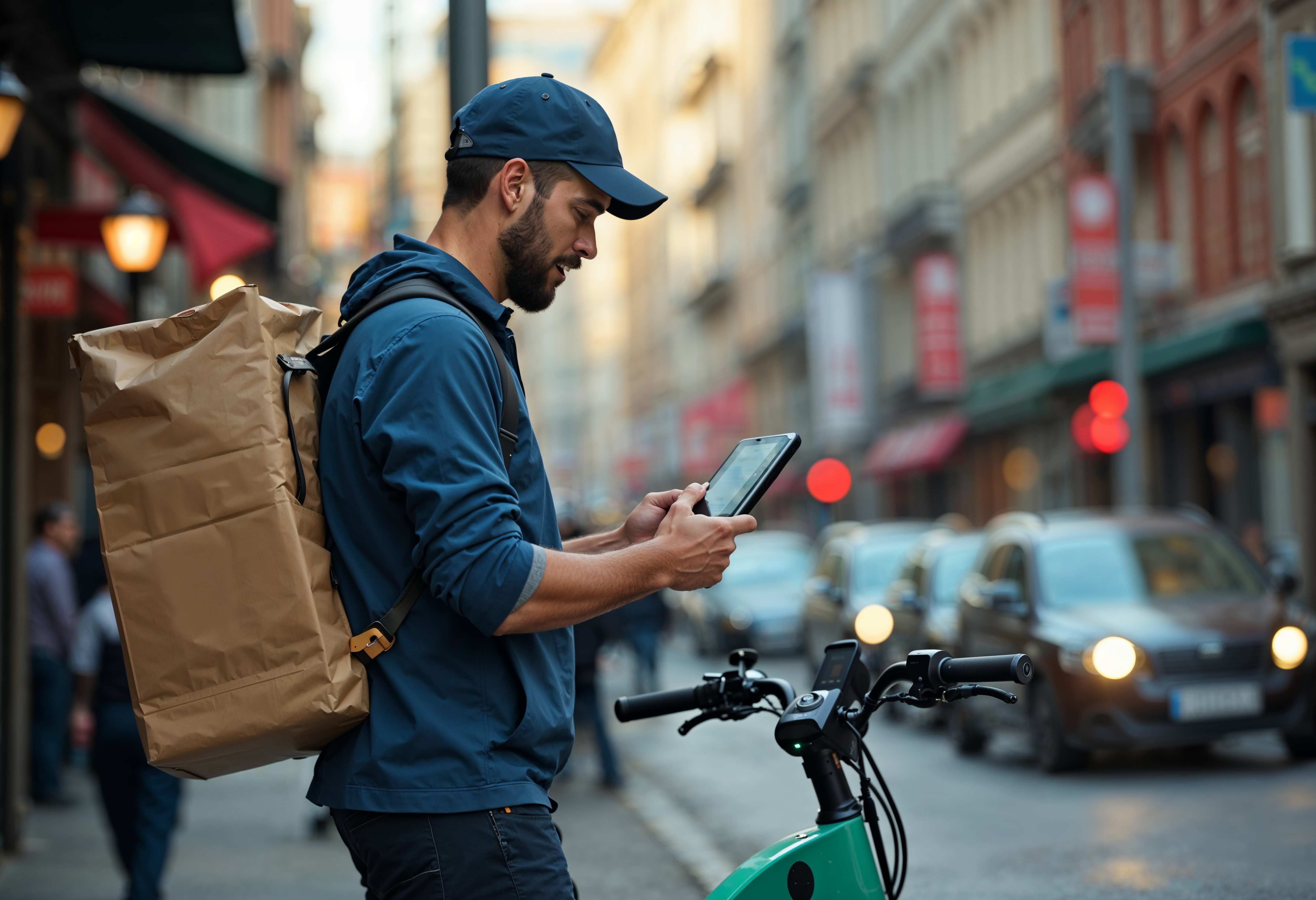
Delivery Driver Tracking App: The Complete Guide for Courier Operations
Tracking your drivers in real time isn't just about oversight — it's how top-performing courier companies cut "where's my package" calls by 80%, reduce unauthorized stops by 40%, and prove delivery completion to clients without disputes.
If you're still relying on drivers to self-report their status via phone calls or WhatsApp groups, you're managing blind. This guide covers what a proper driver tracking app should do, what to look for when choosing one, and what real operations have achieved after implementing one.
What a Delivery Driver Tracking App Actually Does
A driver tracking app is not just a GPS dot on a map. The right system connects:
Real-time location — driver position updated every 30–60 seconds
Stop verification — GPS confirmation that the driver was at the customer's address
Proof of delivery capture — photo, signature, or OTP collected at the handoff point
Route adherence — is the driver following the assigned route or deviating?
Status updates — driver marks deliveries as completed, failed, or rescheduled in real time
Two-way communication — dispatcher can push updated instructions; driver can flag issues
Without all of these, you're not tracking deliveries — you're just tracking vehicles.
Why "Where's My Package" Calls Are Killing Your Support Costs
The average courier company receives 3–5 customer service contacts per 100 deliveries. In a 1,000-delivery-per-day operation, that's 30–50 calls or messages daily, each taking 4–7 minutes to resolve.
The root cause: customers have no visibility, so they call you. The fix: give customers live tracking links tied to your driver's actual GPS position.
When customers can see "your driver is 3 stops away," call volume drops dramatically. One regional courier in the UAE reported an 82% drop in inbound tracking inquiries within two weeks of launching customer-facing live tracking — without adding a single support agent.
Key Features to Evaluate in a Driver Tracking App
GPS Accuracy and Update Frequency
Consumer-grade GPS (updating every 5–10 minutes) isn't sufficient for delivery operations. You need 30–60 second refresh rates to give customers meaningful ETAs and to catch route deviations while they're still correctable.
Also check: does the app work offline? In parts of Africa and Southeast Asia, connectivity drops out mid-route. The app must queue updates and sync when signal returns, not lose the data.
Battery and Data Efficiency
Driver phones run all day. An app that drains the battery by noon is useless. Look for apps that use motion-triggered GPS (higher frequency when moving, lower when stationary) and compress location data before transmission.
Stop Sequence and Dynamic Resequencing
A driver's day isn't static. Customers reschedule, new urgent deliveries get added, addresses fail. The tracking app must be connected to dispatch so that route sequences can be updated in real time and pushed to the driver without requiring a phone call.
Proof of Delivery Integration
GPS tracking and proof of delivery should be captured in the same app action. When the driver marks a delivery complete, the system should simultaneously record: timestamp, GPS coordinates, photo/signature, and (for COD) payment confirmation.
This integration is what makes delivery records defensible if a customer later disputes receipt.
Driver Performance Reporting
Good tracking creates a data trail. Your management dashboard should surface:
Average time per stop
Idle time vs. drive time
On-time delivery rate by driver
Failed delivery rate by driver
Unauthorized stop frequency
This data lets you coach underperformers with specific evidence rather than vague complaints.
iCargos Driver App: Built for MENA, Africa, and Southeast Asia
iCargos built its driver tracking app specifically for operating environments where other platforms struggle. That means:
Offline-first architecture that works in low-connectivity areas
Arabic, French, and English language support within the same driver app
COD confirmation with cash amount recording built into the delivery flow
WhatsApp-native customer notifications triggered by driver GPS events ("your driver has arrived")
For couriers operating across Lagos, Cairo, Riyadh, or Kuala Lumpur, these aren't nice-to-haves — they're operational requirements.
Implementation: What to Expect in the First 30 Days
Week 1: Drivers adapt to recording completions in the app rather than calling dispatch. Expect some resistance — change management matters here. Brief drivers on why this benefits them (fewer "did you actually deliver this?" disputes).
Week 2: Dispatchers start using live maps instead of phone check-ins. Route deviation alerts surface patterns: specific drivers taking longer routes, certain areas with recurring delays.
Week 3: Customer tracking links go live. Inbound "where's my order" inquiries start dropping.
Week 4: First performance reports. Identify your top 20% and bottom 20% of drivers by completion time and failure rate.
Most operations see measurable ROI within the first month — reduced customer service load alone typically justifies the software cost.
Red Flags When Evaluating Tracking Apps
No offline mode — a dealbreaker for MENA and African routes
GPS updates slower than 2 minutes — not sufficient for live customer ETAs
Separate apps for tracking and POD — fragmented workflows slow drivers down
No API for customer notification triggers — you'll never automate the "driver is nearby" message
Per-driver pricing that scales steeply — be wary of cost structures that penalize growth
The Bottom Line
A delivery driver tracking app pays for itself quickly — typically within 60–90 days for operations running 50+ drivers. The primary ROI drivers are:
Reduced customer service volume from self-serve live tracking
Fuel and time savings from route adherence
Eliminated disputes from GPS-verified proof of delivery
Performance management data that reduces failure rates
The technology to run a tight operation is not expensive or complex. What separates high-performing courier companies from average ones is usually just whether they've implemented the right tools.
See how iCargos handles driver tracking for courier operations in MENA and Africa at iCargos.